Why Do We Learn Graph Coloring?
Originally published on MediumA beginner’s guide to a powerful problem-solving tool
Have you ever had to plan a group study schedule, share Wi-Fi with neighbors, or organize events without overlapping time slots? What if I told you that a concept from graph theory — called graph coloring — can help with problems like these?
In college, we often learn graph coloring as part of Discrete Mathematics or Data Structures and Algorithms. At first, it might seem like just a colorful math puzzle. But in real life, it’s a tool used in many important applications like scheduling, networking, map designing, and even building compilers.
Let’s explore it step by step in simple terms.
🌱 What Is Graph Coloring?
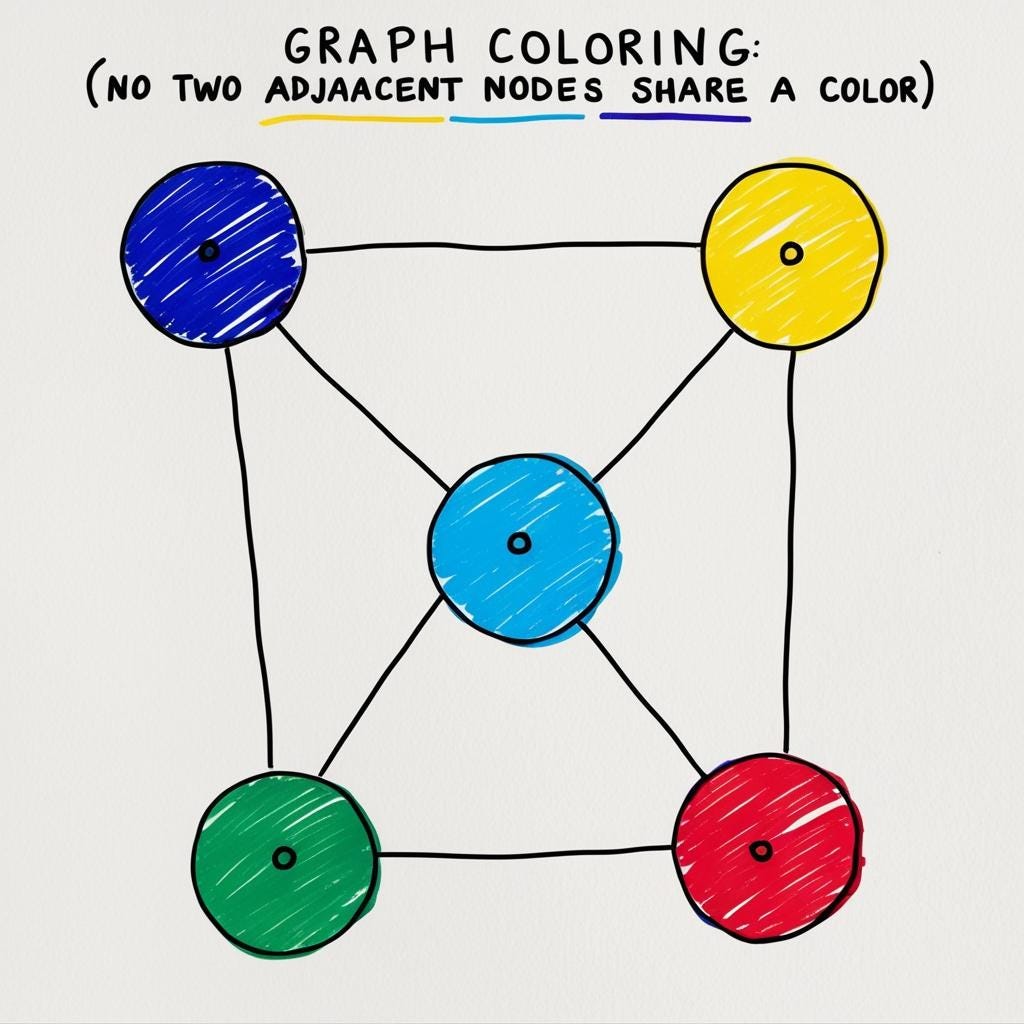
Imagine you have a group of tasks (or locations, or people), and some of them are related in a way that they can’t be grouped together. You draw circles (called vertices) for each task, and connect the related ones with lines (called edges).
Now the goal is to color each circle in such a way that no two connected circles have the same color.
That’s it! That’s the basic idea of graph coloring.
🤔 Why Should We Learn It?
You might think: “Okay, cool… but where is this used in real life?”
Let’s look at some common examples.
Real-Life Uses of Graph Coloring
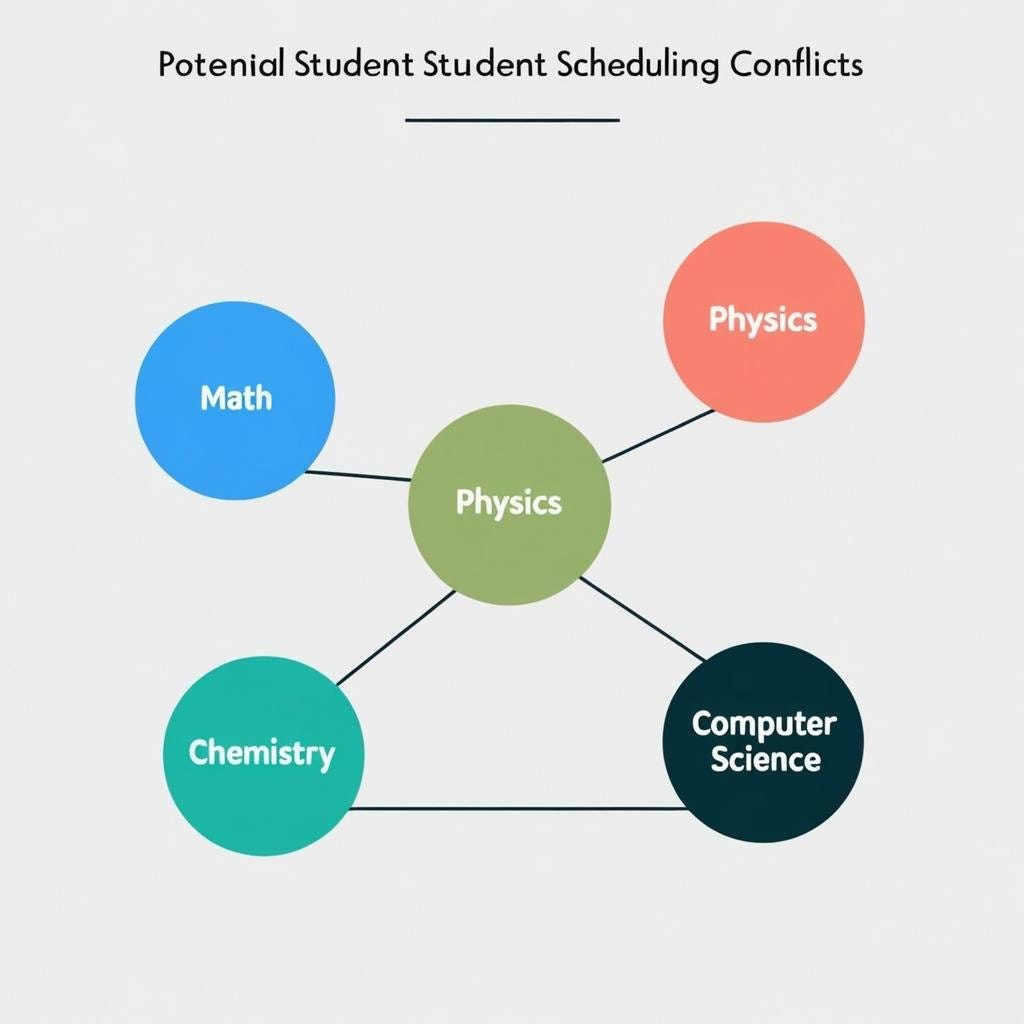
1. Exam or Class Scheduling
In schools or colleges, some students take multiple subjects. So, their exams can’t happen at the same time. Each subject becomes a vertex, and an edge is added between two subjects if any student takes both.
Using graph coloring, we can assign time slots (as colors) so that no overlapping exams happen.
2. Mobile Networks and Wi-Fi
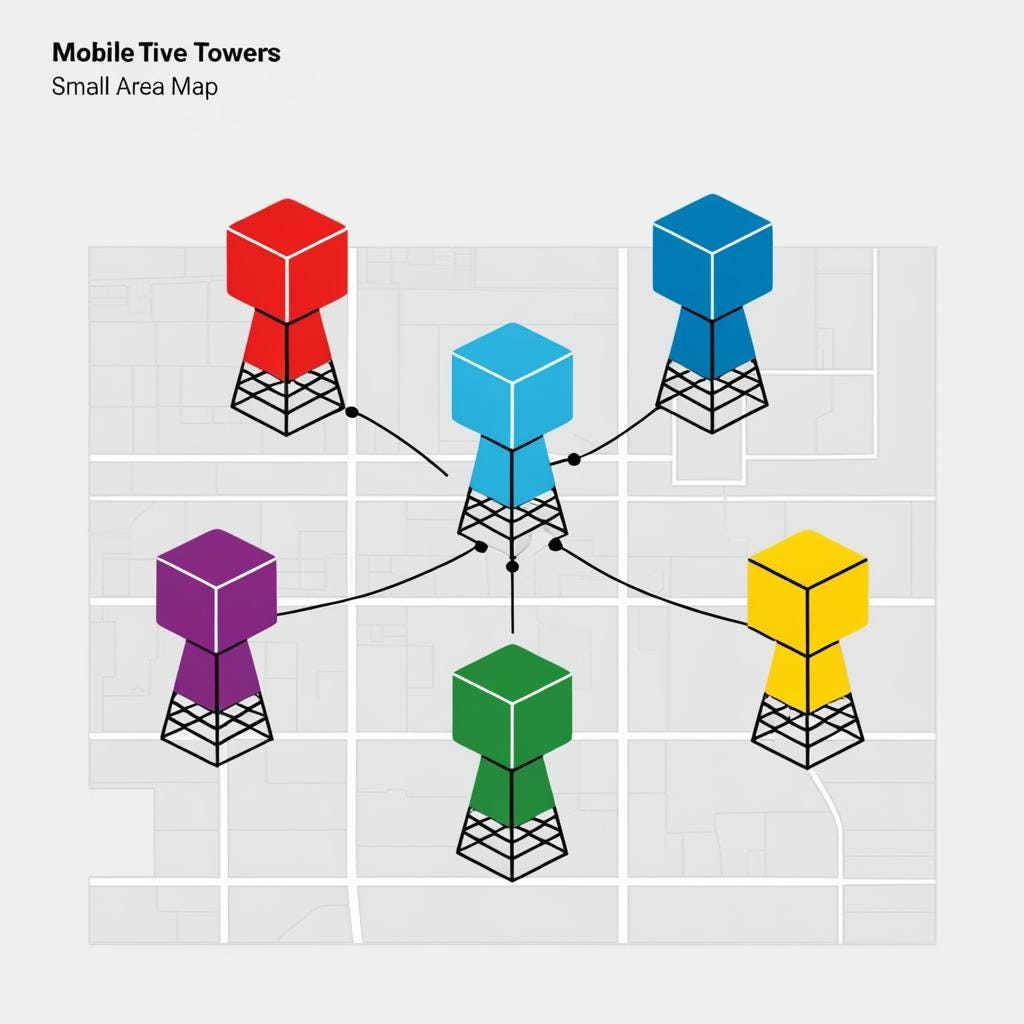
Cell towers or Wi-Fi routers placed close to each other must use different frequencies to avoid signal clashes. Think of each tower as a vertex. If two towers are nearby, we connect them with a line.
Now, using graph coloring, we can assign different frequencies (as colors) to each tower so that no two nearby towers use the same one.
3. Task Assignment in Teams
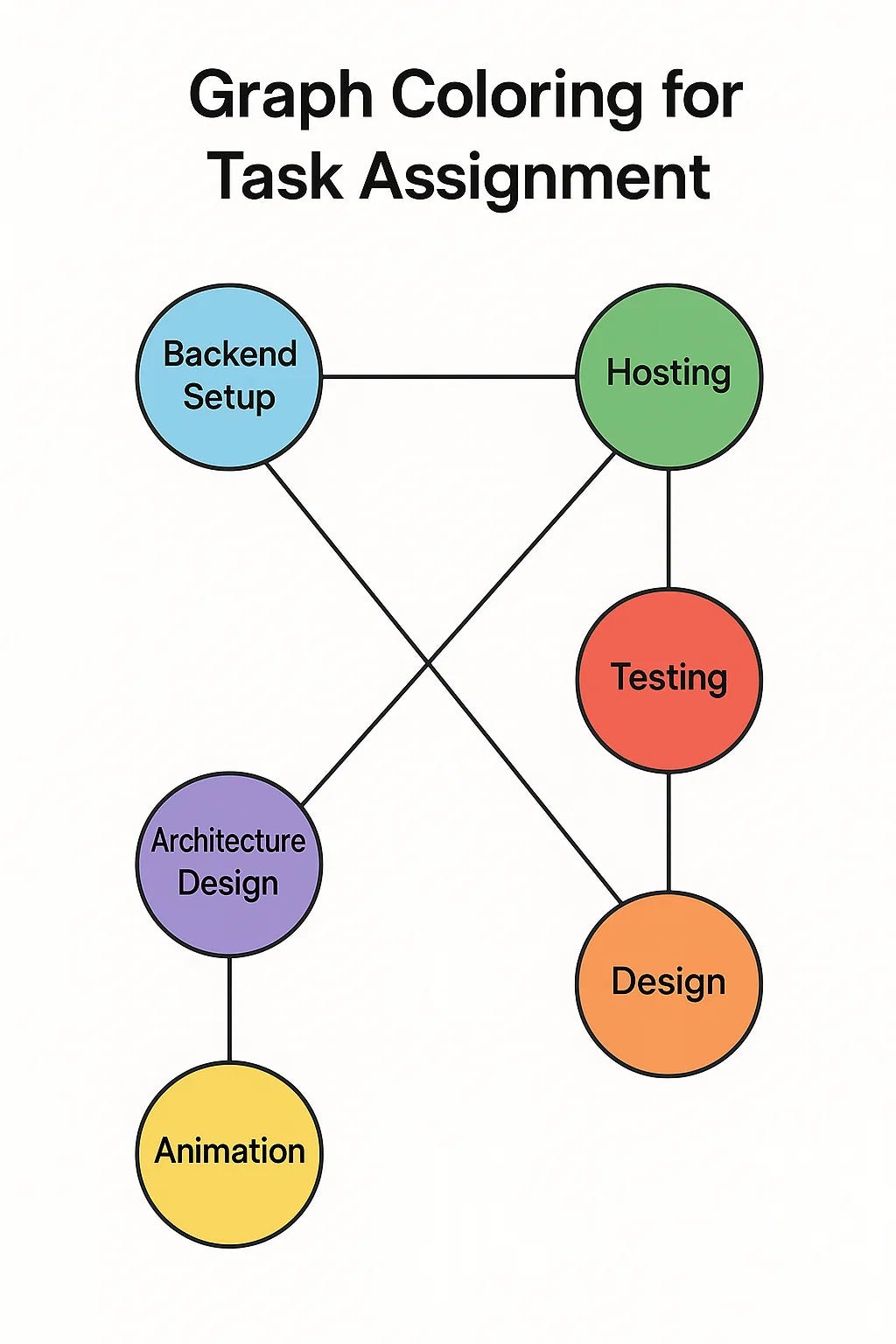
Imagine a project team where some tasks can’t be done by the same person due to time or skill conflicts. Each task is a node, and if two tasks can’t be handled by the same team member, we connect them.
Graph coloring can help assign tasks (colors) to different people, making sure no person gets overlapping or conflicting tasks.
4. Register Allocation in Compilers
In computer programs, values need to be stored in CPU registers. But if two variables are used at the same time, they can’t be stored in the same register.
Graph coloring helps compilers decide where to store variables efficiently by modeling them as a graph.
-> How Does Graph Coloring Work?
There are many ways to solve graph coloring problems. Here are some common methods:
- Greedy Algorithm: Assign the lowest possible color to each vertex one by one.
- Backtracking: Try different color combinations and undo steps when it doesn’t work.
- DSATUR Algorithm: A smarter method that focuses on the most “connected” vertices first.
Conclusion:
Graph coloring may sound like a puzzle at first, but it helps us solve real problems in the real world. It teaches us how to think logically, manage limited resources, and solve conflicts in a smart way.
Whether you’re working on software, planning events, or designing systems, this simple concept can make complex problems easier.
So the next time you hear “graph coloring” in class or an interview, you’ll know it’s not just a theory — it’s a real tool used by engineers, scientists, and developers every day.
THANK YOU FOR LEARNING !!
-Rohit Mane