Why Databases Exist: Evolution of Data Storage
Originally published on MediumA beginner-friendly story explaining how problems in data storage led from primitive data types to data structures, databases, JDBC, and modern ORM frameworks.
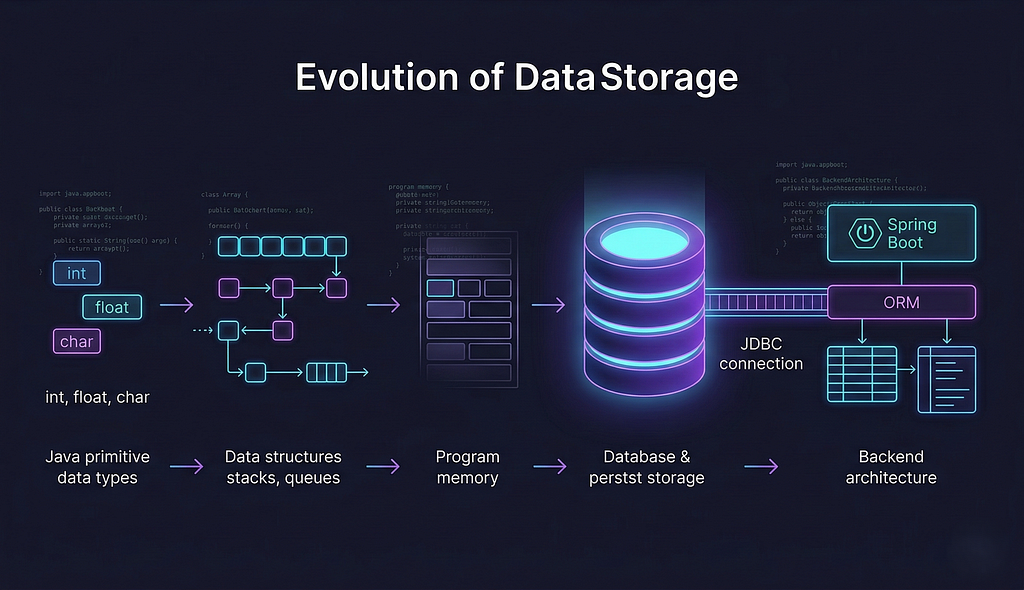
When I first started learning Java, everything felt very basic and mechanical.
Level 0: Data Types
The journey began with data types — int, float, char, double, and others. Each of them had a fixed storage capacity, and I learned that whenever we take input from a user or pass a parameter to a function, we store it inside one of these data types.
At that time, things seemed simple.
If I needed to store a number, I used an int.
If I needed decimal values, I used a float or double.
But soon a question started forming in my mind:
What if I need to store not just one value, but hundreds or thousands of values?
That question slowly led me to the next concept.
The First Upgrade: Data Structures
This is where data structures entered the picture.
Data structures solve a very practical problem. Instead of storing individual values in separate variables, they allow us to store large collections of data under a single logical unit or variable name.
Suddenly, the way we stored data became much more organised.
While studying data structures, I realised that all the data structures have the same goal, which is to store data.
But the real difference lies in how the data is stored and how it is retrieved.
For example:
- Arrays store elements in continuous memory and allow quick index-based access.
- Linked Lists connect nodes dynamically using references.
- Stacks follow the Last In, First Out (LIFO) principle.
- Queues follow the First In, First Out (FIFO) principle.
Each structure exists because it optimizes a specific way of storing and retrieving data.
At this stage, we had solved an important problem:
We could now store much larger amounts of data compared to primitive data types.
But then a new problem appeared.
The Big Problem: Data Was Temporary
All this data was temporary.
When the program was running, everything worked perfectly. We could store data, retrieve it, modify it, and process it.
But the moment we closed the program, everything disappeared.
When we started the program again, the previous session’s data was gone.
This was a huge limitation.
Imagine building a banking application where all customer data disappears every time the server restarts.
Clearly, something was missing.
And this is where databases entered the picture.
Enter Databases: Solving Persistence
Databases solved the problem of data persistence.
Instead of storing data only in the program’s memory (RAM), we could now store it externally on disk, allowing the data to survive even after the program stops running.
In a way, a database can be thought of as a large and structured storage system.It is a kind of data structure where you can decide yourself what kind of structure it should have ( Schema)(for relational Databases).
In relational databases, developers define something called a schema.
A schema describes:
- tables
- columns
- relationships
- constraints
This structure ensures that the data is organized and consistent.
Now developers finally had persistent storage.
Problem solved?
Not completely.
When Data Became Dynamic: The Rise of NoSQL
Over time, developers realized that not all data fits neatly into rigid tables.
Sometimes:
- the structure of data changes frequently
- the data itself is highly flexible
- the relationships are not strictly defined
To handle these scenarios, a new category of databases emerged:
NoSQL databases (schemaless databases).
Unlike relational databases, these systems allow developers to store data without defining a strict schema beforehand.
This flexibility made them useful for applications dealing with large-scale or rapidly evolving data.
But even after solving storage problems, another challenge appeared.
The Communication Problem
Now that the database exists as an external service, the next question becomes:
How does a Java program talk to a database?
If a data structure exists inside the same program, interaction is easy. We simply call methods and manipulate the structure directly.
But when the database lives outside the program, things become more complex.
Now we must deal with:
- network connections
- authentication
- queries
- data transfer
To simplify this interaction, Java introduced JDBC (Java Database Connectivity).
JDBC: The Bridge Between Java and Databases
JDBC acts like a programmatic protocol that allows Java applications to communicate with databases.
Typically, working with JDBC involves a sequence of steps:
- Load the database driver
- Establish a connection
- Create a statement
- Execute a query (CRUD operations)
- Process the result
- Handle exceptions
- Close the connection gracefully
This made database interaction possible for Java applications.
At first glance, life seemed much easier.
But developers soon noticed another problem.
The JDBC Problem: Too Much Boilerplate
Although JDBC worked well, it required a lot of manual code.
Developers had to repeatedly write code for:
- opening connections
- writing SQL queries
- mapping database rows to Java objects
- handling exceptions
- closing resources
This made applications verbose and difficult to maintain.
The Java ecosystem needed a better abstraction.
The Modern Solution: ORM and JPA
To simplify database interaction, developers introduced the concept of ORM (Object Relational Mapping).
ORM allows developers to work with Java objects instead of SQL queries.
The framework automatically maps objects to database tables.
One of the most widely used standards for this approach in Java is JPA (Java Persistence API).
Modern frameworks such as Spring Boot build on top of this idea.
Instead of writing complex SQL queries, developers simply define Java classes that represent database tables.
These classes use annotations to describe how they map to the database schema.
When the application runs, the framework automatically translates these objects into SQL queries and performs the required operations.
As a result, developers can focus on business logic, while the framework handles the database communication behind the scenes.
The Bigger Picture
Looking back, this journey follows a natural evolution in solving problems:
- Data Types → storing single values
- Data Structures → storing collections of data
- Databases → storing data persistently
- JDBC → enabling communication with databases
- ORM / JPA / Spring Boot → simplifying database interaction
Each new layer exists because it solves a limitation of the previous one.
Understanding this progression helps developers appreciate why modern backend technologies exist, rather than just learning them as isolated tools.
What begins with simple variables eventually leads to complete data management systems powering real-world applications.
And that’s one of the most fascinating parts of learning software engineering.
If you enjoyed this explanation, follow me (Rohit Mane) for more beginner-friendly breakdowns of backend engineering, databases, and system design.