Monolithic vs Microservices Architecture: A Practical Guide for Developers
Originally published on MediumA clear comparison of monolithic and microservices architecture, their trade-offs, and when to use each approach in real-world systems.
Before choosing an architecture for any software system, it is important to understand how different architectural styles shape scalability, development speed, and long-term maintenance. Two of the most commonly discussed approaches are Monolithic Architecture and Microservices Architecture.

Let’s break them down clearly and practically.
What Is Monolithic Architecture?
The term monolith originates from ancient history and refers to a single large stone structure, often carved as one solid unit.

In software engineering, Monolithic Architecture follows the same principle.
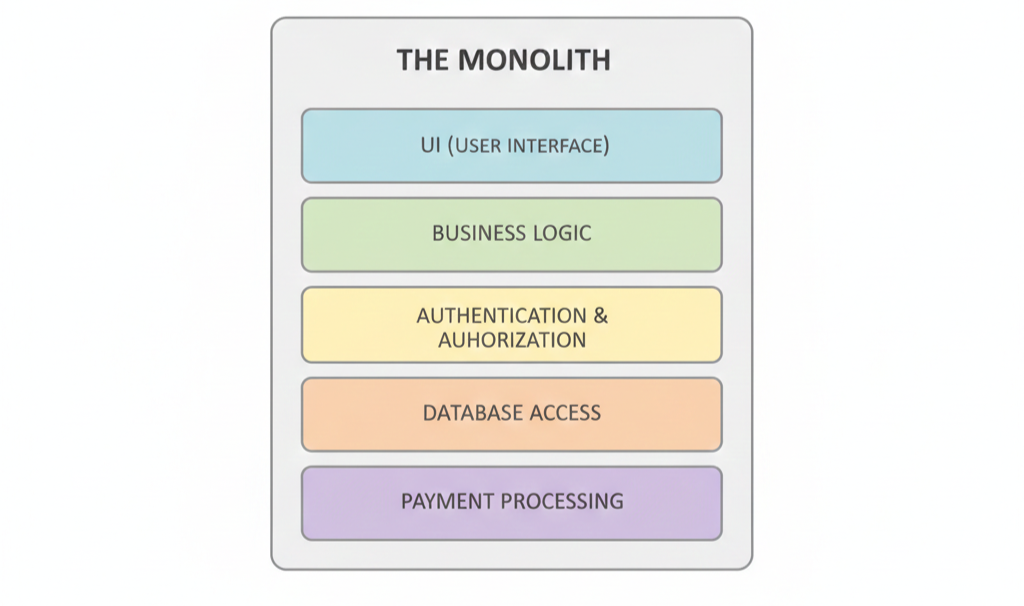
A monolithic application is built as one single, unified codebase, where:
- All business logic
- All features
- All services
are packaged and deployed together as a single unit.
There is no separation of services. Authentication, business rules, UI logic, and database interactions all live inside one application.
This approach is simple, straightforward, and often the starting point for most software systems.
What Is Microservices Architecture?
The term microservices is formed from two words: Micro + Service.
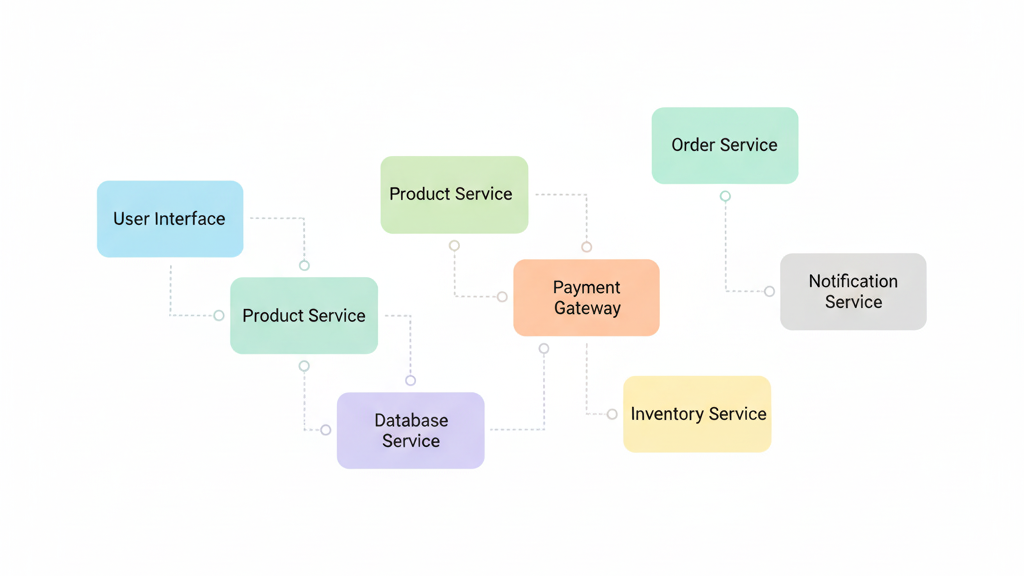
A Microservices Architecture is a design approach where an application is divided into multiple small, independent services, each responsible for a specific business capability.
For example:
- Authentication Service
- User Management Service
- Payment Service
- Validation Service
- Computation or Analytics Service
Each service:
- Runs independently
- Can be developed, deployed, and scaled separately
- Communicates with other services using APIs
Instead of one large system, you get a collection of small, focused systems working together.
Why Monolithic Architectures Become a Problem at Scale
At the early stage of software development, a monolithic architecture works well. However, as the application grows, several challenges begin to appear.
Common Problems with Monolithic Architecture
- Scalability limitations
Even if only one module experiences high traffic, the entire application must be scaled. - Deployment bottlenecks
A small change requires rebuilding and redeploying the full application, slowing down release cycles. - Fault propagation
A failure in one component can crash the entire system. - Technology rigidity
Teams are locked into a single technology stack, making it difficult to adopt better tools or languages later. - Development slowdown
As the codebase grows, complexity increases, onboarding becomes harder, and developer productivity drops.
These limitations led engineers to explore a more flexible architectural approach.
How Microservices Address These Problems
Microservices were designed specifically to solve the scalability and agility issues of monolithic systems.
Key Advantages of Microservices Architecture
- Independent Deployment
Each service can be deployed independently, enabling faster releases and reducing system-wide risk. - Fault Isolation
If one service fails (for example, payments), other services (such as browsing or profile management) continue to function. - Granular Scalability
Only high-demand services need scaling, optimizing infrastructure cost and performance. - Team Autonomy
Small teams can own individual services, enabling parallel development without coordination bottlenecks. - Technology Flexibility
Different services can use different languages or frameworks based on their requirements.
When Should You Use Each Architecture?
There is no universal winner. The right choice depends on scale, team size, and business needs.
Choose Monolithic Architecture When:
- The application is small or medium-sized
- The team is small
- Resources and infrastructure are limited
- You want faster initial development and simpler deployment
Choose Microservices Architecture When:
- The application is growing rapidly
- You need high scalability and availability
- Different parts of the system have different performance needs
- You want strong fault isolation and independent deployments
- Multiple teams are working in parallel
A common and practical strategy is:
Start with a monolith, and evolve into microservices when scale demands it.
Final Thought
Architecture is not about trends — it is about trade-offs.
Monolithic systems offer simplicity and speed at the beginning.
Microservices offer flexibility, resilience, and scalability at scale.
If you found this helpful, feel free to share it with someone learning system design or backend development.