Building a Trustworthy LLM Chatbot for Educational Institutes: A Practical System Design Approach
Originally published on MediumLarge Language Models are impressive — but in education, impressive is not enough.
Answers must be accurate, explainable, and grounded in official material.
This blog documents my ongoing work on designing an LLM-powered chatbot for an educational institute, where students can ask doubts and receive answers strictly based on institute-approved study material uploaded by faculty.
This is not a “chatbot wrapper.”
It is a retrieval-first, confidence-aware, human-in-the-loop system.
The Core Problem in Educational Institutions
In most institutes, knowledge is fragmented:
- PDFs and slides on portals
- Recorded lectures are stored separately
- Notes shared over email or messaging platforms
Students spend more time searching than learning.
Faculty repeatedly answer the same conceptual questions.
Generic AI chatbots are not a solution here — they hallucinate, mix external information, and cannot be audited.
Education requires trust.
Design Principle #1: Answers Must Come From Official Content
The primary constraint I designed around:
The chatbot must answer only from institute-provided material.
This immediately rules out pure prompt-based systems.
Instead, the system follows a Retrieval-Augmented Generation (RAG) architecture:
- Retrieve relevant content first
- Generate answers only from that content
- Say “I don’t know” when confidence is low
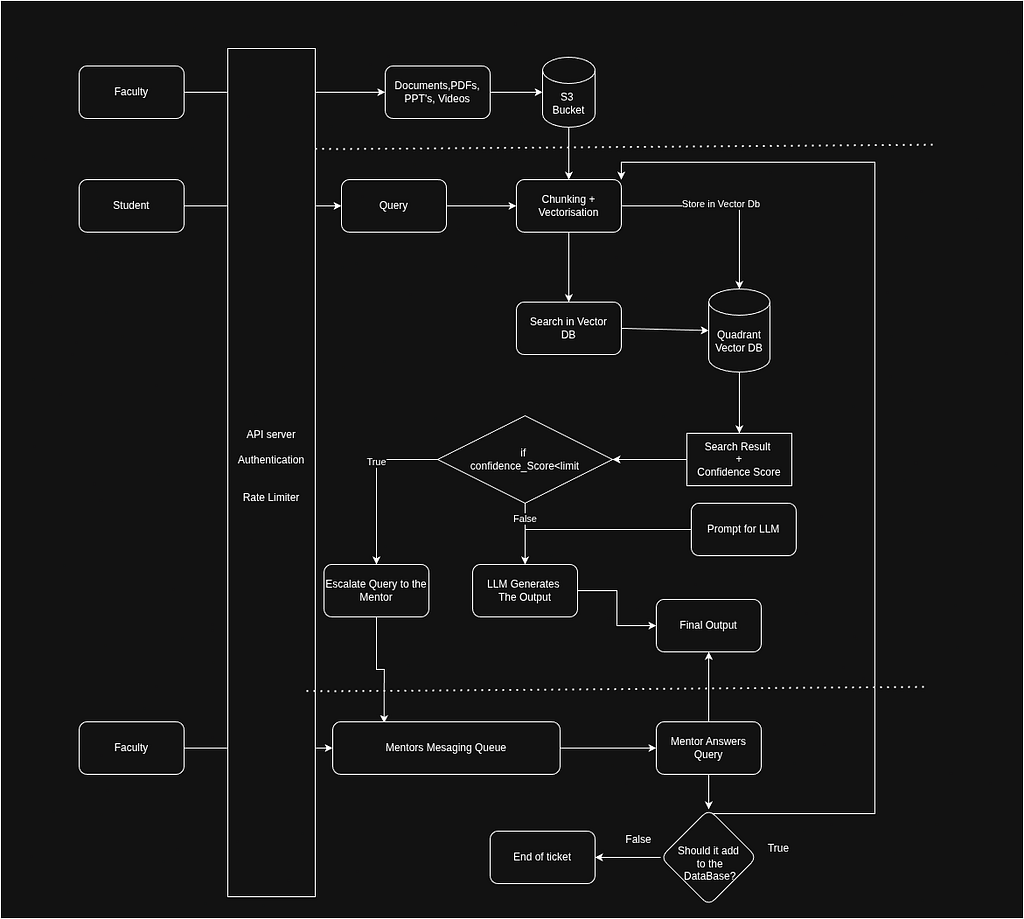
High-Level Architecture Overview
At a system level, the flow looks like this:
- Faculty uploads content (PDFs, PPTs, videos)
- Content is stored and processed
- Student submits a question
- Relevant material is retrieved
- LLM generates a grounded response
- Low-confidence cases are escalated to humans
This design mirrors how real teaching works — refer to the material first, then explain.
Content Ingestion Pipeline
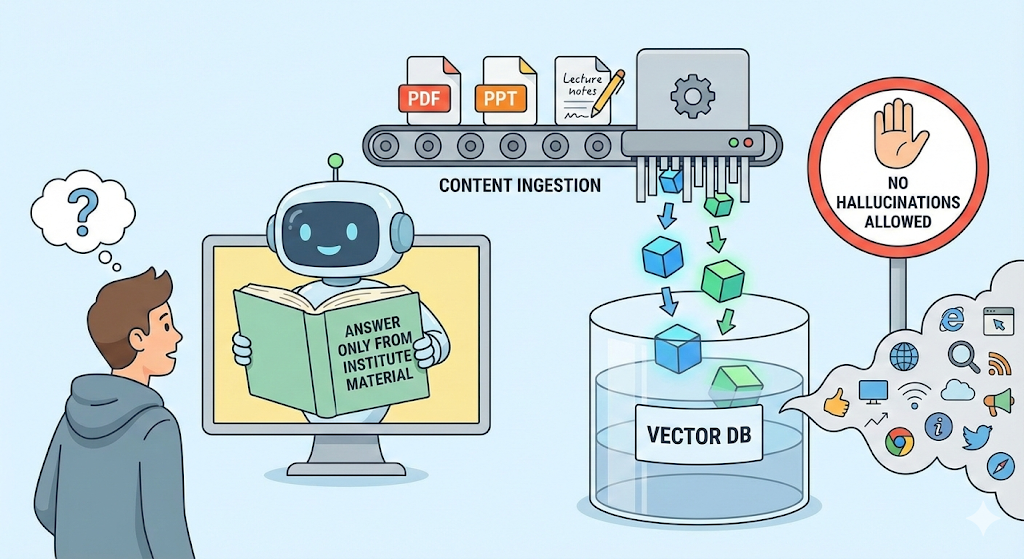
Faculty-uploaded documents are handled as follows:
- Stored securely in object storage (S3)
- Parsed and split into semantic chunks
- Converted into vector embeddings
- Stored in a vector database (Qdrant)
Chunking is critical.
Too large → irrelevant context.
Too small → broken understanding.
The system aims for concept-level chunks, not arbitrary splits.
Query Processing and Retrieval
When a student asks a question:
- The query is converted into an embedding
- The vector database retrieves the most relevant chunks
- A confidence score is computed based on similarity and coverage
- Retrieved context is sent to the LLM with strict instructions:
- Use only the provided context
- Do not assume missing information
This ensures bounded generation.
Confidence-Aware Decision Making
One of the most important design choices:
The system should know when not to answer.
If the confidence score is below a threshold:
- The chatbot does not guess
- The query is escalated
This avoids silent misinformation — a critical risk in education.
Human-in-the-Loop: Mentors as a Feature, Not a Fallback
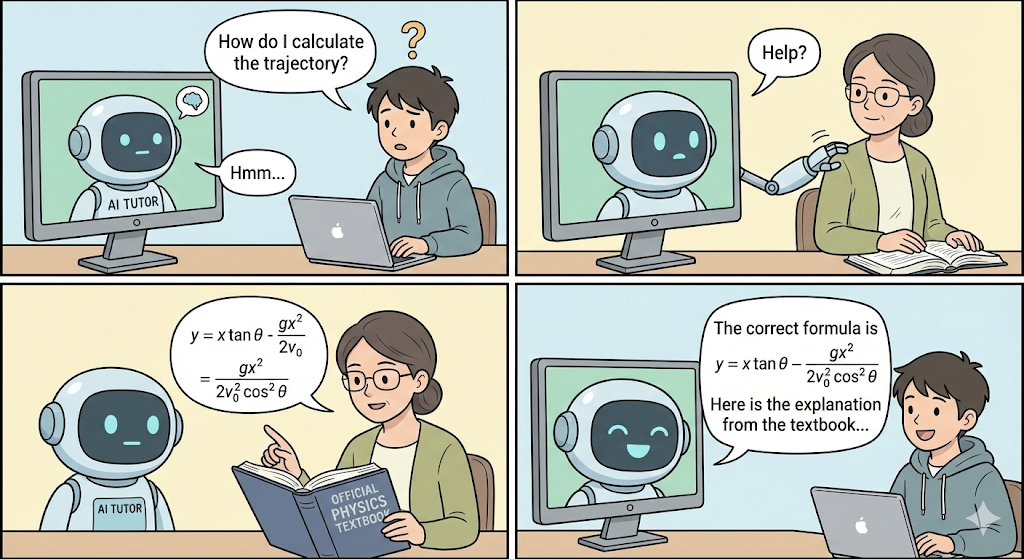
Low-confidence queries are routed to a mentor messaging queue:
- A faculty member or mentor answers manually
- The student receives a verified response
- Optionally, the answer is added back to the knowledge base
This creates a learning system that improves over time.
AI assists — humans remain accountable.
Backend & Production Considerations
Beyond the LLM itself, the system includes:
- Authentication and role-based access (student/faculty/mentor)
- Rate limiting to prevent abuse
- Auditable query and response logs
- Secure APIs for ingestion and querying
LLM systems fail more often due to backend gaps than model limitations.
Why This Approach Matters
This project is not about replacing teachers.
It is about:
- Reducing repetitive load on faculty
- Giving students faster, trustworthy answers
- Ensuring institutional control over knowledge
- Designing AI systems that are safe by default
In educational contexts, accuracy beats creativity.
Key Learnings So Far
Building this system reinforced a few important lessons:
- RAG is a system design problem, not a library choice
- Confidence estimation is as important as generation
- Human-in-the-loop is essential for high-stakes domains
- “Don’t answer” is a valid and necessary output
Final Thoughts
LLMs are powerful, but power without constraints is dangerous — especially in education.
If we want AI to genuinely assist learning, we must design systems that:
- Respect institutional knowledge
- Admit uncertainty
- Keep humans in control
This project is still evolving, but it has already changed how I think about building responsible, production-grade AI systems.
If you’re working on RAG, EdTech, or applied LLM systems, I’d love to exchange ideas.